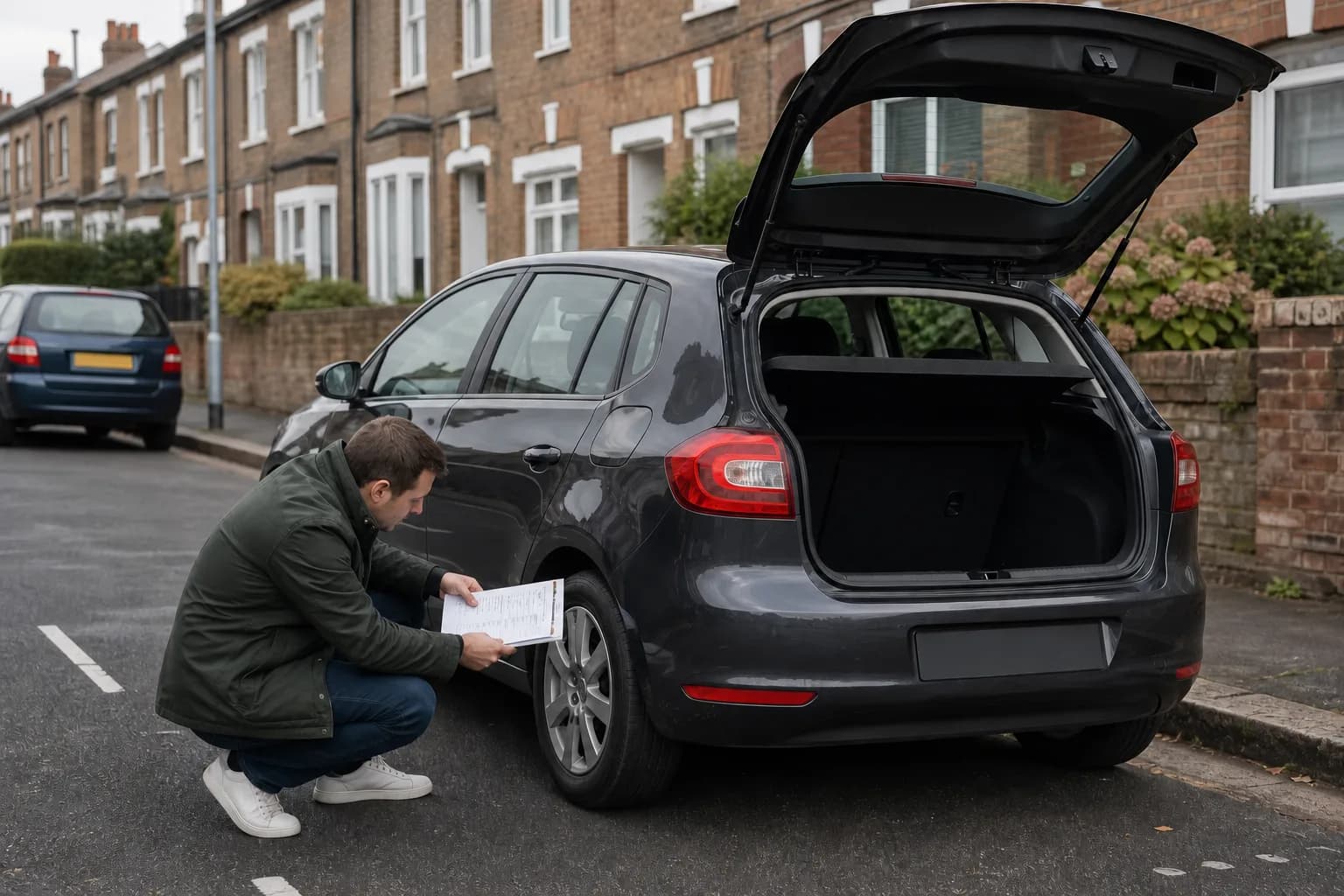
A good used-car check starts before the viewing. The aim is not to prove that a car is perfect; it is to make the advert, documents, vehicle and seller tell one consistent story. Use this checklist to decide what to verify and when uncertainty is high enough to walk away.
Before contacting the seller
Save the advert, photographs, price and seller details. Note whether the seller describes themselves as private or trade and whether they have several vehicles listed. Search the registration on the free GOV.UK MOT history service if it is visible.
Write down the exact model, year, engine, gearbox and trim claimed. Model-specific advice is only useful once the version is known. Compare the price with similar cars, but remember that the cheapest example can need the most explanation.
Check the advert closely
Look for specific evidence rather than adjectives. “Serviced in March at 62,400 miles” is verifiable; “maintained regardless of cost” is not. Note missing photographs, inconsistent mileage, a short MOT, vague service history, warning lights, unrepaired faults and urgency around deposits.
Check whether the photographs appear to show the same car throughout. Different wheels, trim, number plates or surroundings can indicate reused images or an advert assembled from several sources.
Confirm identity and registration
Ask for the registration before travelling. Compare the official make, model, colour, fuel type and MOT status with the advert. At the viewing, check the VIN on the car against the original V5C.
The V5C identifies the registered keeper; it is not proof that the keeper owns the car free of finance. For a private sale, view at the keeper's address where possible and understand any mismatch before proceeding.
Read the MOT history in order
Do not look only at the latest pass. Follow mileage from test to test and note repeated advisories, failures, corrosion, tyre wear, brakes, suspension and emissions entries. A repeated advisory may suggest deferred work; a failure followed quickly by a pass should prompt a request for the repair invoice.
An MOT records minimum testable standards on one day. It does not assess every mechanical component and is not a warranty.
Examine the service history
Ask for the service book, digital record and invoices. Check dates, mileages, registration and VIN references. Identify scheduled work relevant to that exact engine and gearbox, including time-based items. Phone the garage using contact details found independently if a crucial invoice looks unclear.
Gaps do not automatically make a car bad, but they reduce what you can verify. Adjust your decision, inspection effort and price expectations accordingly.
Inspect the car before it starts
Arrange to see the car in daylight and dry conditions if possible. Ask the seller not to warm it up. Before starting:
- Look underneath for fresh drips and inspect visible fluid levels only when safe.
- Check tyre tread and condition across the full width of all four tyres.
- Compare panel gaps, paint finish, lamps and glass.
- Test doors, locks, windows, seats, belts and supplied keys.
- Look for damp, mould, warning stickers and signs of water in the boot.
- Compare wear on pedals, steering wheel and driver's seat with the stated mileage.
Do not crawl under an unsupported vehicle. A buyer's visual check is not a substitute for a lift inspection by a qualified person.
Start it from cold
Check that warning lights illuminate during the self-test and then extinguish as expected. Listen for persistent rattles, knocks or uneven running. Look for smoke, but remember that condensation can be normal in cold weather. Do not diagnose a fault from one symptom; use it as a reason for professional assessment.
Let the car reach normal temperature while watching for warnings, leaks, cooling-fan behaviour and unusual smells.
Take a meaningful test drive
Confirm that you are insured. Try the car at parking speed, over rougher surfaces, under gentle and firmer braking, and at a suitable faster road speed. Test reverse, hill starts, clutch take-up or automatic engagement, steering, gears and straight-line braking.
Turn the audio off. A short loop chosen to hide speed-related or warm-running symptoms tells you little. If the seller will not allow a reasonable test or independent inspection, do not let urgency replace evidence.
Decide before paying
Step away from the car and review your notes. Do the advert, seller, V5C, VIN, MOT history, service file and physical condition agree? List unresolved questions and decide whether an inspection or separate vehicle-history check is needed.
Never send money because someone claims another buyer is waiting. If you use a deposit, record the vehicle, amount, conditions and whether it is refundable. Verify bank details in person and do not pay a third party without a clear, verified reason.
Handover
Create a signed receipt for both parties showing names and addresses, registration, VIN, mileage, price, date and time, payment method, keys supplied, and specific statements relied on. Keep the advert and messages.
Use the official DVLA process to change the registered keeper. The buyer must tax the car before driving because tax does not transfer with the vehicle. Arrange insurance before taking possession.
When to walk away
Stop when the VIN or V5C does not match, the seller's identity cannot be established, finance cannot be resolved, the car is unavailable to inspect, important answers change, warning lights are dismissed without evidence, or payment is being rushed elsewhere.
Walking away is not an accusation. It is a decision that the remaining uncertainty is greater than the value of the deal.