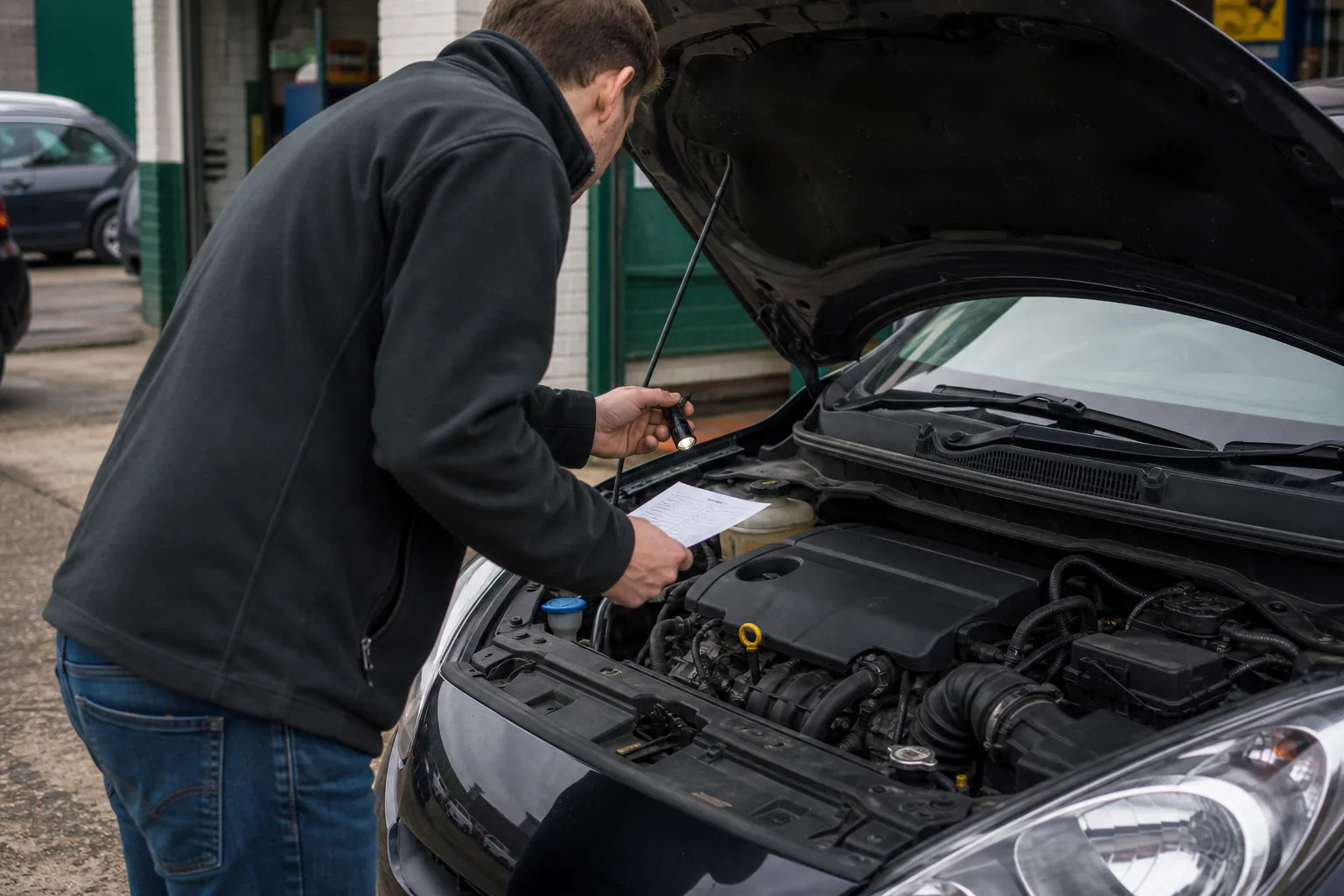
Good questions save wasted journeys, but the answer is only the start. Ask in writing where practical, keep the advert, and compare the seller's claims with the car, the V5C, service records and MOT history at the viewing.
Ownership and reason for sale
Ask “How long have you owned the car, and why are you selling it?” A short ownership period is not automatically a problem, but it needs a coherent explanation. Follow with “Is the car yours to sell, and will the person named on the V5C be present?” A V5C records the registered keeper; it is not proof of ownership on its own.
If someone is selling for a relative or friend, ask to speak to that person and understand why they are absent. If the answers keep changing, stop and verify before travelling.
V5C and vehicle identity
Ask whether the original V5C is available and whether its registration, VIN, make, model and colour match the car. Do not ask the seller to send a photograph showing the document reference number; GOV.UK warns sellers to protect that number.
At the viewing, compare the VIN shown through the windscreen and on the vehicle with the document. Do not accept an explanation that the paperwork will arrive later as a substitute for checking identity.
Service history and maintenance
“Full service history” can mean a stamped book, digital manufacturer records, invoices, or simply a seller's claim. Ask:
- What date and mileage was the last service?
- Which garage did it, and is there an invoice?
- Which scheduled items are due next?
- Is there evidence for timing-belt, gearbox-fluid or other version-specific work?
- Are there gaps, and what explains them?
Check that dates and mileages progress logically. A pile of receipts is helpful only if it belongs to the same car.
MOT advisories and repairs
Read the free MOT history before calling. Ask about each repeated advisory and recent failure: “What was repaired, when, and is there an invoice?” A fresh pass does not prove that every advisory was repaired, and the MOT is a minimum roadworthiness check at one point in time—not a warranty.
Warning lights, faults and recent work
Ask directly: “Are any warning lights on now, or have any appeared recently?” Then ask whether fault codes were read and what repair was completed. A cleared warning light without a diagnosis is not reassuring.
Also ask about oil or coolant loss, overheating, starting problems, unusual noises, smoke, leaks, air-conditioning faults and intermittent electrical issues. Avoid yes-or-no shorthand such as “all good?”
Accidents, bodywork and insurance history
Ask whether the car has been involved in a collision, had insurance repairs, or received paint or structural work. Cosmetic repairs are not necessarily a reason to reject a car, but undisclosed work changes the trust calculation.
Keys, equipment and recalls
Ask how many keys are included and whether each works. Confirm that locking-wheel-nut keys, charging cables, parcel shelves and removable accessories advertised with the car will be handed over. Ask whether any safety recalls are outstanding, then verify the answer using the official GOV.UK recall service.
Outstanding finance and other history
Ask “Is there any outstanding finance, and are you authorised to sell the car?” The free MOT history does not answer that question. A separate vehicle-history check may cover finance, theft and insurance write-off data. If finance is disclosed, verify the settlement process independently with the finance provider.
Viewing location and test drive
For a private sale, ask to view at the seller's home address and compare it with the V5C. A neutral meeting point removes a useful identity check. Ask whether the engine can be left cold and whether a proper test drive is possible. Confirm insurance before driving.
Deposit and payment
Ask before travelling whether a deposit is expected, whether it is refundable, and how final payment will work. Do not send money simply to stop another buyer viewing. Confirm bank details in person, use a traceable method, and wait for both parties to see that cleared funds have arrived before handover.
When the answers should stop the deal
Walk away when identity cannot be verified, the V5C or VIN does not match, the seller will not allow a reasonable inspection, payment is rushed to a different person, or important answers change. You do not need to prove fraud to decide that the uncertainty is too high.
Write the key answers into a receipt signed by both parties, with the vehicle, price, date, mileage and any specific statements about condition. Keep copies of the advert, messages and payment record.